CyberMath's Blogs
The Chessboard Puzzle That Explains Competition Math (Even If You Never Compete)
Cut two corners off a chessboard and 31 dominoes should fit the 62 squares left. They never do. Here is the three-sentence reason, and the four thinking habits competition math builds in every student, medal or not.
Beyond the Answer: Why Proof Is the Part of Math Worth a Whole Summer
School math teaches students how to get the answer. Proof teaches them why it is true. Here is what proof-based math is, a two-minute proof anyone can follow, and why we build our summer math camps around it.
Shape Is Everything: The Idea That Connects Biochemistry and Medicine
A protein works because of its shape, a drug works because it fits, and a poison often works the same way in the wrong place. Here is how one idea, shape, connects biochemistry to medicine, through carbon monoxide, prions, insulin and drug design.
Learning Python and AI One-to-One: Where a High School Student Should Start
Learning AI is a stack of skills: programming, algorithms, machine learning and the math underneath. Here is where a beginner should start, the one idea at the heart of machine learning, and why coding is easier to learn with a tutor beside you.
Understanding First: Three Ideas Behind How We Teach at CyberMath
No adjectives, just a plain description: the three ideas behind every CyberMath program (understanding before speed, working at the edge of what a student can do, and teachers who do the subject) and how they look in tutoring, research and summer camps.
Six Questions to Ask Before Choosing a Summer Math Camp
Camp brochures all sound alike. Here are six concrete questions to put to any summer math program — curriculum, teachers, placement, life outside class, day or residential, and what a student leaves with — and how CyberMath answers them.

The Gap Is Usually Smaller Than It Looks: What One-to-One Tutoring Actually Fixes
A disappointing grade feels like a cliff, but the cause is usually one specific gap. Here is how one-to-one online tutoring finds it, what we tutor, who teaches, and what the free 45-minute introductory session is for.
What Eight Weeks of Real Research Does to a High School Student
Our professor-led research program starts October 12: eight weeks online with Prof. Ahmet Yildiz of UC Berkeley, built around real medical mysteries and the molecular science underneath them. Here is what it is, how it runs, and who it is for.

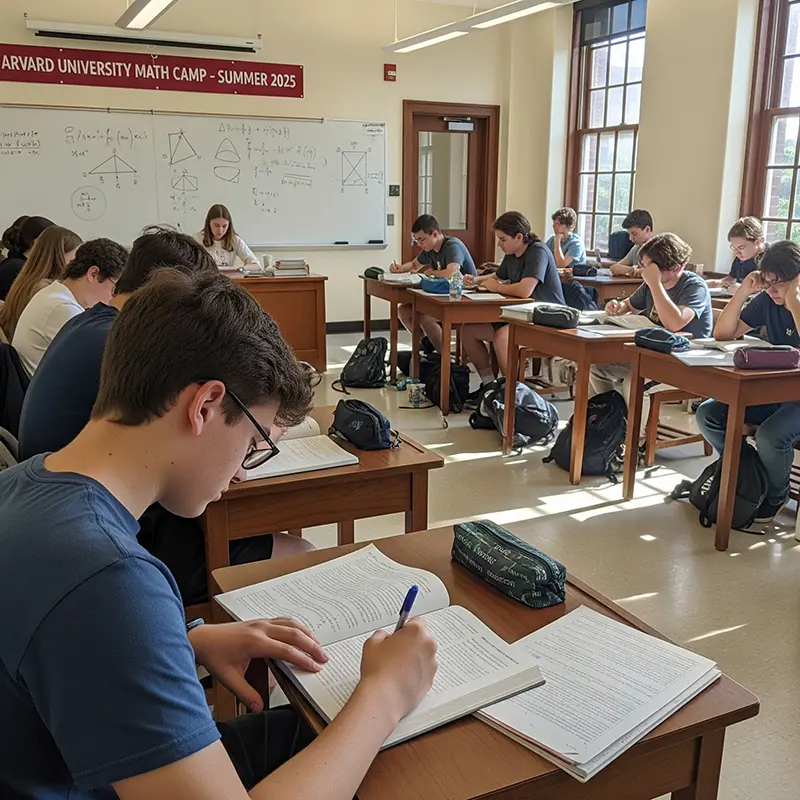
What Happens to a Child’s Mind at Math Camp
What Happens to a Child’s Mind at Math Camp Most parents who send their child to a math camp are hoping for a simple outcome: their child will get better at mathematics. And that does happen. But it is rarely what the child remembers years later. What they remember is something harder to name. A […]

The Myth of Natural Math Talent — What the Research Actually Shows
There is a story we tell about mathematicians. They were always different. They saw patterns other people missed. Numbers made sense to them in ways that felt effortless — almost involuntary. They were, in some fundamental sense, born for it. This story is not entirely false. Some people do encounter mathematical ideas with unusual ease. […]

Why Math Gets Harder at a Certain Age — and What to Do About It
Something happens to many students around the ages of eleven to thirteen. Children who were doing perfectly well in mathematics — who found arithmetic manageable, who could follow along in class, who didn’t think of themselves as having a problem with maths — suddenly find it hard. Not just harder. Genuinely, unexpectedly difficult in a […]
Is My Child a Math Person? Why the Question Is Wrong
At some point in most children’s mathematical education, a question forms in a parent’s mind: Is my child a math person? It usually emerges after a difficult homework session, a disappointing exam result, or an offhand comment from a teacher. The child struggled. The child found it hard. And the parent — having perhaps struggled […]