
Six Questions to Ask Before Choosing a Summer Math Camp
Summer feels a long way off in October. But this is when many families start comparing programs, and it is a good time to do it calmly, with months to compare options rather than weeks.
The trouble is that most camp brochures look alike. Every program promises inspiring teachers, beautiful campuses and a transformative experience. Those words are easy to write and hard to compare. What helps more is a short list of concrete questions that you can put to any camp, ours included, and that have real answers.
Here are the six we would ask, and how CyberMath’s summer math camps answer them. We have been running summer camps for nine years, and these are the questions that, in our experience, separate a summer a student remembers from one they simply attended.
1. What will my child actually be learning?
“Enrichment” can mean almost anything. Ask to see the curriculum, and look for whether it goes somewhere a school year does not.
Our camps run two math courses. Advanced Middle School Math, for grades four to eight, builds the foundations of mathematical reasoning: proof-writing and competition preparation. Advanced High School Math, for grades nine to twelve, moves through algebra, calculus and linear algebra and opens the door to real analysis. Both come in Foundations and Mastery options, so a strong student and a very strong student are not forced into the same room.
The emphasis is on proof-based reasoning, formal mathematical writing and logical rigor. That is the part of mathematics school rarely has time for, and it is usually the part that makes a student fall in love with the subject.
There is also an AI and Machine Learning track, available at all locations, that requires no prior experience. Students work in Python, learn how neural networks are built, and do hands-on projects.
2. Who is teaching?

This matters more than the campus. A beautiful building does not teach anyone anything.
Our classes are taught by IMO medalists and AI researchers, people who have done mathematics at the highest level and can explain why it works, not just how. Guest lectures bring in researchers from outside the camp, including Dr. Michele Catasta in computer science and Dr. Umut Eser in machine learning. You can meet more of the people behind CyberMath on our faculty page.
A useful follow-up question for any camp: will my child be taught by the people named on the website, or by someone else? It is fair to ask, and a good program will be glad you did.
3. Is it the right level for this student?
A camp that is too easy is a vacation with worksheets. A camp that is too hard is a summer of quiet discouragement. Neither is what you are paying for.
Ask how students are placed. At our camps, placement uses a two-exam series: a Middle School Exam and a High School Exam. Students in 8th grade and below start at Middle School Foundations, 9th to 12th graders start at High School Foundations, and high scores may qualify a student for the Mastery level. The aim is simple: every student should spend the session at the edge of what they can do, not far beyond it and not comfortably inside it.
4. What happens outside the classroom?
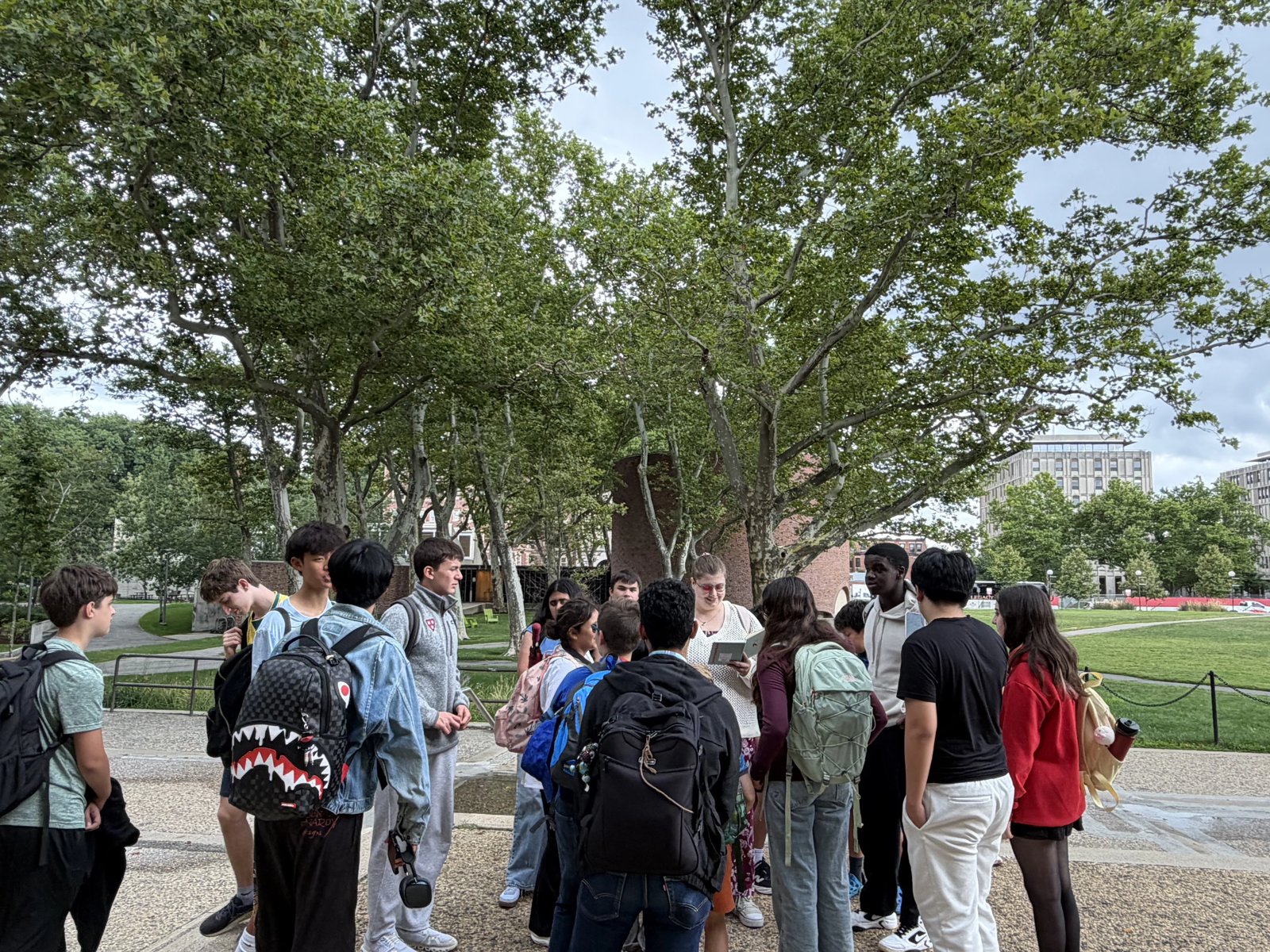
A residential summer is also a student’s first taste of living and learning somewhere new, and the hours outside class shape how they remember it.
Our programs include visits to university campuses such as Harvard, MIT, the Bodleian Library and Christ Church, and in Silicon Valley, technology companies like Google, Apple, NVIDIA and Meta. The Boston program takes in historic sites along the Freedom Trail; the Oxford program includes a tour of the city’s colleges and excursions to London. Evenings bring formal dinners, scavenger hunts, karaoke, innovation challenges and, in Oxford, punting.
None of that replaces the mathematics. It is what makes a group of strangers into a group of friends who argue about proofs at dinner, and that is part of the education too.
5. Day or residential?
Ask whether you have a choice, and what each option actually includes.
Our camps offer both. Day students attend classes and daytime activities; residential students also live on site, with accommodation and meals included, and an evening study period built into the day. On the Harvard program page you can see how a day is structured: classes in the morning, lunch, then afternoon activities, tests or trips. For a first time away from home, a residential camp with that kind of clear rhythm is often easier than parents expect.
6. What does the student leave with?
A good summer should leave something behind besides photos.
Our students receive letter grades and a certificate of completion, so the work is assessed honestly rather than simply attended. Recommendation letters are available on a case-by-case basis for students whose work stands out. More important than any document, though, is a change in how a student approaches a hard problem: more patience, more willingness to write down a careful argument, less fear of being stuck.
Where things stand for summer 2027
Our summer 2027 camps are planned for three locations: Boston, at the Harvard Faculty Club in Cambridge; Silicon Valley; and Oxford, at St Edward’s School. They are open to students aged nine to sixteen. Dates are still to be announced, and we will publish them on each location’s page as soon as they are confirmed.
You can read the details for Harvard and Oxford now, and when you are ready, the application form takes a few minutes and lets you choose the course and level that fits your student.
If you are starting to think about next summer, start with these six questions. Then explore our summer math camps and see how the answers compare.