The Myth of Natural Math Talent — What the Research Actually Shows
by CayberMath Academy • Jun 11 2026 • Blog
There is a story we tell about mathematicians. They were always different. They saw patterns other people missed. Numbers made sense to them in ways that felt effortless — almost involuntary. They were, in some fundamental sense, born for it.
This story is not entirely false. Some people do encounter mathematical ideas with unusual ease. Some children do seem to grasp abstract relationships that leave their peers baffled. These observations are real. What is false — or at least deeply misleading — is the conclusion we draw from them: that mathematical ability is a fixed, innate quality distributed unequally across the population, that some people have it and others don’t, and that education’s job is largely to sort one group from the other.
This conclusion does not follow from the observations. And the evidence against it is considerably stronger than most people realize.
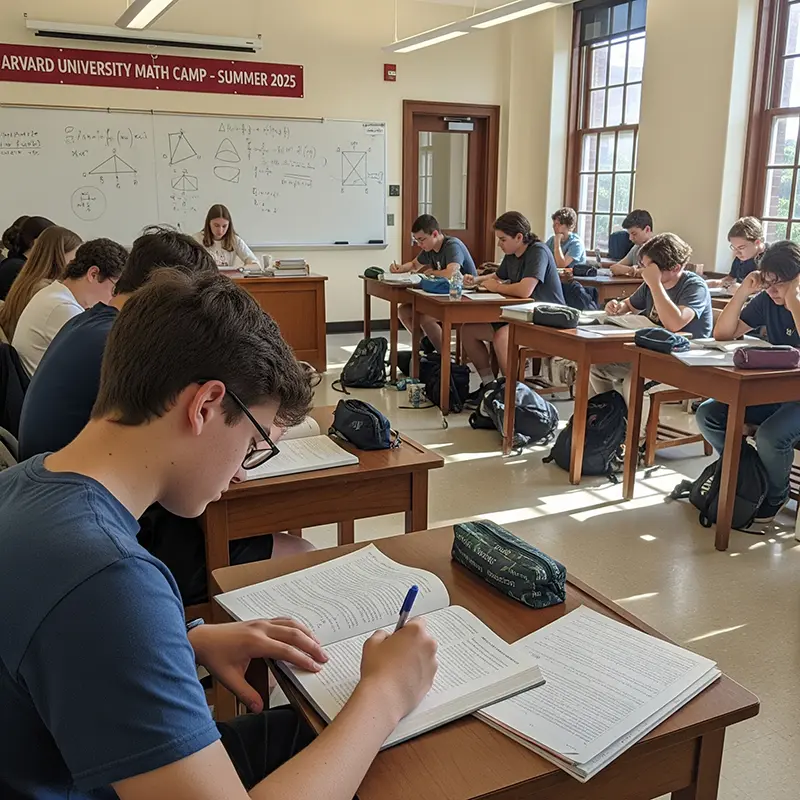
CyberMath Academy · Summer Math Camp at Harvard · Boston, MA · July 20–31, 2026
Where the Myth Comes From
The myth of natural mathematical talent has several sources, and understanding them helps explain why it is so persistent even in the face of contradicting evidence.
The first source is survivorship bias. The mathematicians we know about — the ones who appear in history books, who win prizes, who become professors — are a highly selected group. We observe their extraordinary abilities and conclude that those abilities must have been innate. We do not observe the many people who had similar early promise but whose development was shaped by different educational opportunities, different cultural contexts, or simply different choices about where to invest their effort.
The second source is the invisibility of early learning. Mathematical ability develops over years and decades, through thousands of hours of accumulated experience. But when we encounter a child who seems effortlessly good at mathematics, we don’t see those accumulated hours. We see the product — a child who processes mathematical ideas quickly and confidently — and we interpret it as evidence of something innate, because the process that produced it is invisible.
The third source is the self-fulfilling nature of the label. Once a child is identified as naturally talented at mathematics, they receive more mathematical stimulation, more encouragement, more challenging problems, more time with people who take their mathematical development seriously. The label creates the conditions that justify it. And children who are not identified as talented receive less of all these things — which makes it increasingly unlikely that they will develop the abilities that would have challenged the original assessment.
What the Research Actually Shows
The scientific evidence on mathematical ability is more nuanced, and considerably more optimistic, than the talent myth suggests.
Mathematical ability is not a single trait
There is no single “mathematical ability” that can be measured, ranked, and used to sort children into those who have it and those who don’t. Mathematical competence is a collection of distinct capacities — spatial reasoning, working memory, pattern recognition, logical inference, numerical intuition, abstract thinking — that develop at different rates in different people, and that respond differently to different kinds of instruction and experience.
A child who struggles with arithmetic may have exceptional spatial reasoning. A child who finds algebra difficult may have strong logical inference skills that would make them an excellent mathematician if those skills were engaged by the right kind of problems. The reduction of all this complexity to a single dimension — “good at maths” or “not good at maths” — discards most of the information that would actually be useful for supporting a child’s mathematical development.
Heritability does not mean fixedness
Twin studies consistently show that mathematical performance has a heritable component — identical twins are more similar in mathematical ability than fraternal twins. This finding is real and not in dispute. But it is routinely misinterpreted.
Heritability does not mean that a trait is fixed or that it cannot be substantially changed by environment. Height is highly heritable, but average heights have increased dramatically across generations as nutrition improved — the same genes, producing different outcomes in different environments. The heritability of mathematical performance tells us that genetic factors play a role. It does not tell us that those factors determine outcomes, or that the environment cannot substantially modify them.
More importantly, the genetic influences on mathematical performance are massively polygenic — involving thousands of genetic variants, each contributing a tiny effect. There is no “math gene.” The genetic architecture of mathematical ability is so distributed and so intertwined with environmental factors that it offers essentially no predictive power at the level of the individual child.
Cross-cultural evidence undermines the talent myth
If mathematical ability were primarily innate, we would expect to see similar distributions of mathematical achievement across different cultures. We do not. The differences in mathematical performance between high-achieving and low-achieving countries are so large that they cannot plausibly be explained by genetic differences between populations. Japan, Singapore, Finland, and South Korea consistently produce students with dramatically higher mathematical achievement than many other countries — not because of genetic differences, but because of differences in educational culture, curriculum design, teacher preparation, and the social value placed on mathematical effort.
Within countries, similarly striking differences exist between schools, between classrooms, and between students taught by different teachers. These differences track educational quality and expectation, not innate ability.
The research on deliberate practice
Anders Ericsson’s research on expert performance — summarized in what became known as the “10,000 hours” concept, though this simplification somewhat distorts his findings — showed that expert performance in a wide range of domains, including mathematics, is primarily explained by the quantity and quality of deliberate practice rather than by innate talent.
Ericsson and his colleagues studied chess grandmasters, concert pianists, elite athletes, and expert mathematicians. In virtually every domain, the experts had accumulated far more deliberate practice hours than non-experts — and within the expert group, performance differences were substantially explained by practice differences rather than any measurable baseline difference in ability.
The mathematicians in these studies were not born knowing how to do mathematics. They became mathematicians through thousands of hours of engaged, structured mathematical thinking. The process was long and sometimes difficult, even for those who later appeared most talented.
The “Early Genius” Problem
One of the most compelling pieces of evidence for innate mathematical talent is the existence of what appear to be child prodigies — children who, with seemingly little instruction, grasp mathematical ideas that take most adults years to understand.
These children are real. But close examination of their histories consistently reveals something the “innate talent” narrative obscures: they have almost always had extensive, rich mathematical experience from a very early age. The experience was often playful, informal, and driven by the child’s own curiosity — but it was experience nonetheless. The apparent effortlessness of their mathematical ability is the product of years of accumulated engagement, not the absence of it.
The mathematician Terence Tao, often described as the greatest living mathematician, showed extraordinary early ability. He was also the child of a mathematician father who engaged him in mathematical thinking from infancy, in a household where mathematical ideas were normal dinner conversation. László Polgár, the Hungarian educator who set out to prove that genius could be created through early specialization, raised three daughters who all became chess grandmasters — through deliberate, structured education, not genetic selection.
None of this proves that there are no differences in initial aptitude between children. There almost certainly are. But the magnitude of those differences, and their importance relative to educational experience, is far smaller than the talent myth suggests.
The Cost of the Myth
The belief in natural mathematical talent is not merely inaccurate. It is actively harmful — and it is harmful to everyone, not just to children who are labeled as untalented.
For children labeled as lacking mathematical talent, the damage is obvious. They are given less challenging material, lower expectations, and a narrative about themselves that makes mathematical effort seem both futile and somehow embarrassing. A child who has been told they are “not a math person” is not just facing a false belief — they are facing a belief that, once internalized, tends to confirm itself through the mechanisms of motivation and avoidance.
For children labeled as naturally talented, the damage is subtler but real. These children often develop what psychologist Carol Dweck calls a “fixed mindset” about their mathematical identity. If your mathematical ability is something you were born with, then encountering a problem you cannot solve is not a normal part of mathematical learning — it is a threat to your identity. Talented students sometimes avoid exactly the kind of difficult, sustained mathematical engagement that would develop their abilities most effectively, because difficulty feels like evidence that the talent they were told they had is not actually there.
At CyberMath Academy, we see this dynamic regularly. Some of the most mathematically gifted students — those who arrive with the strongest prior preparation and the highest test scores — are also among the most fragile when they encounter genuinely hard problems. The students who ultimately go furthest are often those who have already learned to treat difficulty as information rather than judgment.
What Produces Mathematical Excellence
If natural talent is not the primary explanation for mathematical excellence, what is?
The research points consistently toward several factors that are all, to varying degrees, within our control.
Early exposure to mathematical thinking. Not drill and memorization, but genuine mathematical thinking — puzzles, patterns, problems with multiple solutions, questions without obvious answers. Children who encounter this kind of thinking early, in contexts where it is interesting and safe to be wrong, develop the cognitive foundations that later make formal mathematics more accessible.
The quality of instruction. This is perhaps the most powerful factor. A great mathematics teacher — one who understands the subject deeply, who can explain ideas multiple ways, who treats errors as learning opportunities — can produce dramatic improvements in mathematical achievement regardless of students’ starting points. The difference between the best and worst mathematics teachers, in terms of student outcomes, is larger than the difference between wealthy and low-income schools.
Belief in the possibility of improvement. Students who believe that mathematical ability can be developed through effort consistently outperform students of similar initial ability who believe it is fixed. This is not merely correlational — experimental studies that have taught students about the growth mindset have produced measurable improvements in mathematical performance, particularly for students who previously believed they were not “math people.”
Access to challenge. Mathematical ability develops through engagement with problems that are genuinely difficult — problems at the edge of the student’s current ability. Students who are given only problems they can solve easily do not develop the resilience, the problem-solving strategies, or the conceptual depth that mathematical excellence requires. Challenge is not a reward for talent. It is the mechanism through which talent is built.
Time and persistence. Mathematical understanding accumulates over years. The students who become strong mathematicians are not those for whom it was always easy — they are those who kept going when it was hard, who returned to problems they couldn’t immediately solve, and who developed the metacognitive habit of asking themselves why a solution works, not just whether it does.
A Different Kind of Mathematical Education
The myth of natural mathematical talent has shaped mathematics education in ways that are difficult to dislodge. Tracking systems, which place children in different mathematical paths based on early assessments of “ability,” institutionalize the myth. Curricula that emphasize speed and correct answers over understanding reward the children who have had early advantages and penalize those who haven’t. A culture in which adults casually announce that they were never good at maths teaches every child who hears it that mathematical failure is acceptable and expected.
A different kind of mathematical education — one built on the actual evidence about how mathematical ability develops — looks quite different. It involves rich, challenging problems at every level. It treats errors as data, not failures. It provides time for deep engagement rather than rapid coverage. It maintains high expectations for all students while providing differentiated support. And it teaches students explicitly about how mathematical ability works — that it is built through effort and engagement, not conferred at birth.
This is what we try to do at CyberMath Academy’s Summer Math Camp at Harvard — July 20–31, 2026, Harvard Faculty Club, Boston, MA. We work with students aged 9–16, at all levels of prior preparation, and we operate from the assumption that every student who arrives is capable of mathematical growth. The question is never whether. It is always how.
“My son was told at age ten that he was not academically gifted. He came back from two weeks at CyberMath Academy having presented an original combinatorics proof to a room full of students and faculty. The same child. Two weeks.”
— Parent · Germany · CyberMath Academy Summer 2025
The Right Question
The myth of natural mathematical talent asks the wrong question. It asks: does this child have what it takes? And it answers that question too early, on the basis of too little evidence, with consequences that are difficult to reverse.
The right question is: what experiences has this child had, and what experiences do they need? It treats mathematical ability not as a fixed endowment to be measured but as a developmental achievement to be supported. It holds open the possibility that the child who currently struggles with mathematics might, with different instruction, different expectations, and different opportunities, become something quite different from what current performance would suggest.
The evidence supports this possibility. The talent myth does not.