Beyond the Answer: Why Proof Is the Part of Math Worth a Whole Summer
Ask most students what math is, and they will describe a routine: learn a method, practice it, get the answer, check it against the back of the book. That routine matters. It builds fluency, and fluency is useful. But it leaves out the part of mathematics that mathematicians themselves care about most: explaining why something is true, so clearly that nobody could reasonably doubt it.
That explanation has a name. It is called a proof. And for a curious student, learning to read and write proofs is often the moment math stops being a list of procedures and starts being a subject worth thinking about.
Here is what proof-based math is, what it looks like with a real example, and why we build our summer camps around it.
What school math usually skips
A typical school year has a lot to cover and not much time. So classes understandably focus on getting students to the right answer, reliably and quickly. The question of why a method works is often mentioned once, then left behind.
The result is a familiar kind of student: good at math tests, but unsure what to do when a problem does not look like the examples. They have learned what to do, but not how to reason when no recipe is available.
Proof-based math turns that around. Instead of starting with a method, it starts with a claim and asks a simple question: how do we know?
What a proof actually is
A proof is a chain of reasoning that starts from things we already accept and arrives, step by step, at something new. Each step has to follow from the ones before it. Nothing is allowed to rest on “it seems to work” or “I tried a few cases.”
That last part is the key. Checking examples is a fine way to discover a pattern, and mathematicians do it all the time. But a pattern that holds for ten cases, or a thousand, can still fail at the next one. A proof is what turns a good guess into something certain.
Writing a proof also forces a kind of honesty. You cannot hide a vague step behind a correct final number. If one link in the chain is weak, the whole argument is weak, and a careful reader will notice. Students who learn this start to read their own work more critically, in math and well beyond it.
A proof you can follow in two minutes
Try this. Add up odd numbers in order, and watch the totals:
- 1 = 1
- 1 + 3 = 4
- 1 + 3 + 5 = 9
- 1 + 3 + 5 + 7 = 16
Every total is a perfect square: 1, 4, 9, 16. It is tempting to stop there and declare the pattern true. But four examples are not a proof. Will it still work for the first hundred odd numbers? The first million?
Here is one way to see that it always works. Picture the squares as dots arranged in a grid. A 1 by 1 square is a single dot. To grow it into a 2 by 2 square, you add an L-shaped border of 3 dots. To grow that into a 3 by 3 square, you add a border of 5 dots. Each new border wraps around two sides of the previous square and meets at the corner, so it always has two more dots than the one before. The borders are exactly the odd numbers, in order.
So adding the first n odd numbers is the same as building an n by n square, one border at a time. The total is n times n. Not because we checked some cases, but because we can see why it has to be.
Notice what happened. The arithmetic was easy. The real work was finding a way to look at the problem that made the answer unavoidable. That is what proof-based math trains, and it is a skill that transfers to harder problems, to competitions and, later, to research.
Why proof-writing changes how students think
Students who spend real time on proofs tend to change in a few recognizable ways.
They get more comfortable being stuck. A proof rarely arrives on the first try, so students learn that being stuck is a normal stage of thinking, not a sign that they are bad at math.
They write more clearly. A proof has to make sense to someone else, so students learn to state what they are assuming, say what they are trying to show and connect each step to the last.
They ask better questions. Once you know that a pattern needs a reason, you start asking for reasons everywhere: in science, in an argument, in a news story.
None of this replaces practice with standard methods. It sits on top of it and gives it meaning.
How our summer camps teach proof
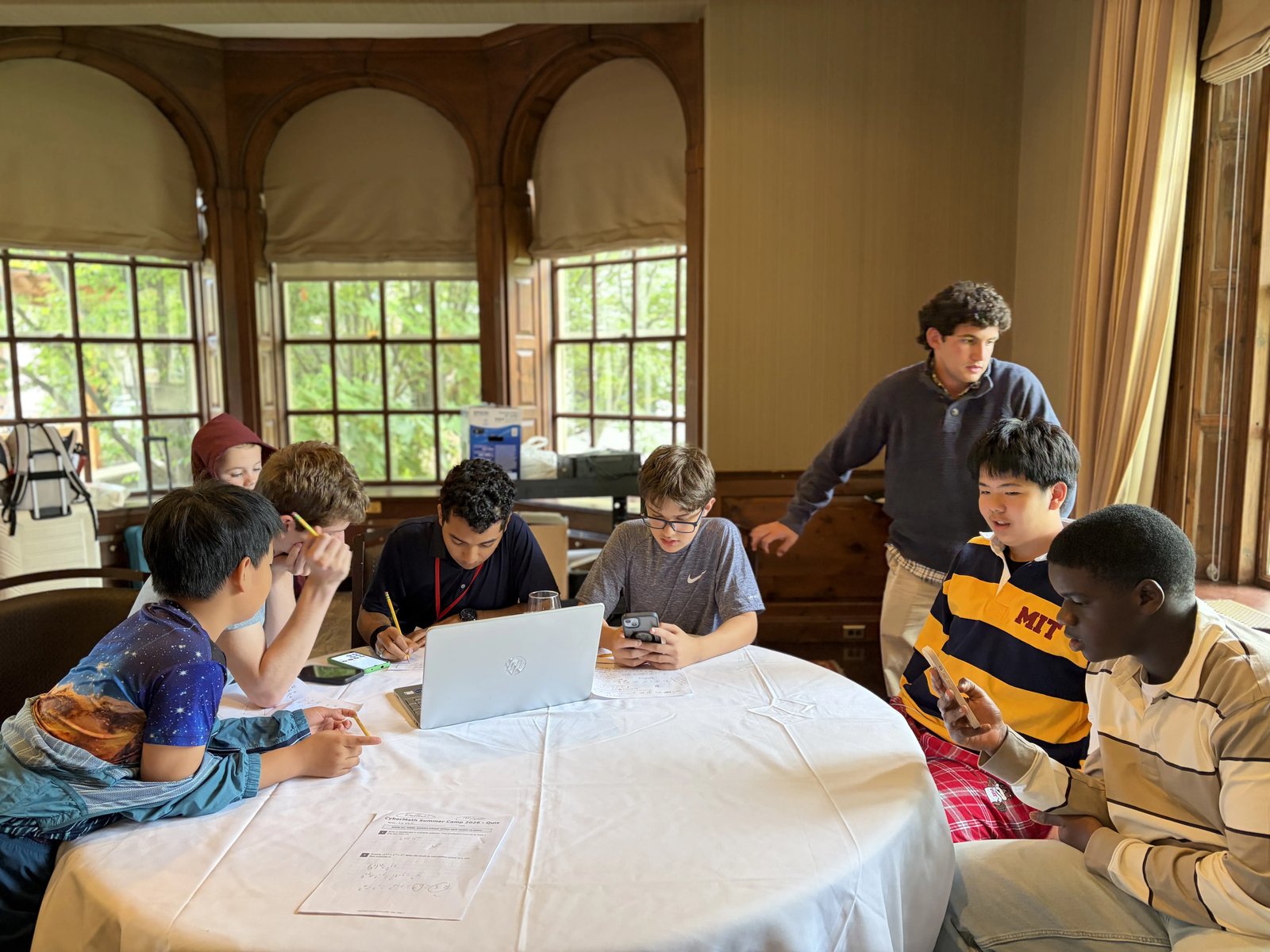
Proof-based reasoning is at the center of CyberMath’s summer math camps, for students aged nine to sixteen.
Advanced Middle School Math, recommended for advanced fourth to eighth graders, covers the foundations of mathematical reasoning, an introduction to proof-writing, problem-solving strategies and competition math preparation. Advanced High School Math, recommended for advanced ninth to twelfth graders, moves through advanced algebra and calculus, proof-based mathematics, and linear algebra and complex numbers.
Classes are taught by IMO medalists and AI researchers, and they are assessed honestly: students receive letter grades with instructor comments, every student receives a Certificate of Completion, and students who earn a B or higher receive a Certificate of Mastery. For students who also want to build things, there is an AI and Machine Learning track at every location, with Python programming, neural networks and hands-on projects, and no prior experience required.
Our summer 2027 camps are planned in Boston at the Harvard Faculty Club, in Silicon Valley, and in Oxford at St Edward’s School, with both day and residential options. Each location’s page shows its latest details.
Getting started before summer
You do not need to wait for a camp to try this kind of thinking at home. Pick a pattern, like the odd numbers above, and ask your student not just whether it is true, but why. Ask them to explain it to you in full sentences. If they can convince you, they are already doing mathematics.
If a student wants guidance along the way, our one-to-one online tutoring can work on reasoning and problem-solving during the school year. And for older students drawn to the question of how we know what we know, our online research program brings that same habit of asking why into real science.
When you are ready to plan next summer, explore our summer math camps and find the course and level that fits your student.