What Is Machine Learning? A Complete Guide for Students and Parents
by CayberMath Academy • May 17 2026 • Blog
Every time Netflix recommends a show, every time your email filters spam, every time a self-driving car decides when to brake — machine learning is at work. It is the technology behind virtually every AI system that has changed daily life over the last decade.
And yet most students — and most parents — cannot explain what it actually is.
This guide changes that. No jargon. No shortcuts. A genuine explanation of what machine learning is, how it works, why it matters, and what it means for students who want to understand — and eventually shape — the technology that will define their generation.
CyberMath Academy · Harvard Faculty Club · Boston, MA · July 20–31, 2026
The Simple Definition
Traditional computer programs work by following explicit rules. A programmer writes instructions: if this happens, do that. The program executes those instructions exactly as written. It does nothing its programmer did not anticipate.
Machine learning is different. Instead of writing rules, you show the system examples — thousands, millions, or billions of them — and let it find the patterns on its own. The system learns from data rather than following pre-written instructions.
Here is the definition stated precisely: machine learning is a method of training computer systems to make predictions or decisions by learning patterns from data, without being explicitly programmed with the rules for every situation.
Three words in that definition deserve attention: patterns, data, and learning. They are not metaphors. They describe real mathematical processes — and understanding those processes is what separates people who can build AI from people who can only use it.
How Machine Learning Actually Works
The machine learning process has three stages: data, a model, and training. Here is what each means.
Stage 1: Data
Machine learning begins with data — examples of the thing you want the system to learn about. If you want to build a system that recognizes handwritten digits, you need thousands of images of handwritten digits, each labeled with the correct number. If you want to build a spam filter, you need thousands of emails labeled “spam” or “not spam.”
The quality and quantity of data matters enormously. A system trained on limited data learns limited patterns. A system trained on biased data learns biased patterns. “Garbage in, garbage out” applies more precisely in machine learning than almost anywhere else in technology — and understanding why is one of the most important things a student can learn about AI.
Stage 2: The Model
A machine learning model is a mathematical structure that takes data as input and produces a prediction as output. The simplest model is a linear function: output = weight₁ × input₁ + weight₂ × input₂ + … The model’s parameters (weights) are the numbers that determine how inputs are combined to produce outputs.
More complex models — neural networks — have millions or billions of parameters, organized into layers. Each layer transforms the data in a specific way, passing its output to the next layer. The final layer produces the prediction. Understanding why this architecture works requires linear algebra, calculus, and probability theory — all of which are taught at CyberMath Academy.
Stage 3: Training
Training is the process of adjusting the model’s parameters until its predictions become accurate. Here is how it works:
Step 1 — Forward pass: Feed a training example into the model. Get a prediction.
Step 2 — Calculate the loss: Compare the prediction to the correct answer. The difference is the loss — a number measuring how wrong the prediction was.
Step 3 — Backpropagation: Calculate how much each parameter contributed to the loss. This uses the chain rule from calculus — one of the most important mathematical tools in all of machine learning.
Step 4 — Gradient descent: Adjust each parameter slightly in the direction that reduces the loss. Repeat thousands of times across all training examples.
After enough training iterations, the model’s parameters settle into values that produce accurate predictions — not just on the training data, but on new examples the model has never seen. That ability to generalize is what makes machine learning genuinely powerful.
The Three Types of Machine Learning
Not all machine learning works the same way. There are three major paradigms, each suited to different kinds of problems.
Supervised Learning
In supervised learning, every training example comes with a correct answer — a label. The model learns to predict the label from the input.
Examples: image classification (input: image, label: “cat” or “dog”), spam detection (input: email, label: “spam” or “not spam”), house price prediction (input: features of a house, label: sale price).
Supervised learning is the most common form of machine learning and underlies most of the AI applications people encounter daily. It requires labeled data — which is expensive to produce, because a human must label each example.
Unsupervised Learning
In unsupervised learning, the training data has no labels. The model must find patterns and structure in the data on its own.
The most common unsupervised learning task is clustering — grouping similar examples together without being told what the groups are. Spotify’s recommendation system uses clustering: it groups songs that are often listened to together, and groups listeners who have similar listening patterns, then recommends songs listened to by similar listeners.
Unsupervised learning is harder to evaluate than supervised learning — without labels, there is no obvious “correct answer” to measure accuracy against. But it is also more flexible, because it does not require the expensive process of labeling data.
Reinforcement Learning
In reinforcement learning, a system learns by taking actions in an environment and receiving rewards or penalties based on the outcomes. There is no fixed dataset — the system generates its own experience through interaction.
This is how the AI systems that defeated human champions at chess (AlphaZero) and the video game Go (AlphaGo) were trained. It is also used in robotics, autonomous vehicles, and recommendation systems that optimize for long-term engagement.
Reinforcement learning is mathematically the most sophisticated of the three paradigms — it draws on probability theory, dynamic programming, and game theory, as well as the neural network machinery of supervised learning.
What Machine Learning Cannot Do
Machine learning is powerful. It is also genuinely limited — and understanding those limitations is as important as understanding the capabilities.
It requires data. A human child can learn to recognize a cat from a handful of examples. A machine learning model typically needs thousands or millions. The data dependency is both a practical limitation and a deeper insight: machine learning systems have no innate understanding. They have statistical patterns extracted from data.
It can fail on unfamiliar inputs. A model trained to recognize cats in photographs taken indoors may fail on outdoor photographs, or on drawings of cats, or on photographs taken at unusual angles. This brittleness — performing well on familiar distributions and poorly on unfamiliar ones — is one of the central challenges in deploying machine learning reliably.
It inherits the biases of its data. If the training data reflects historical biases — as most real-world data does — the model will learn and reproduce those biases. Facial recognition systems trained predominantly on certain demographic groups perform worse on others. Language models trained on internet text absorb the full spectrum of human expression, including its worst aspects. These are not bugs that can be easily patched. They are structural features of the learning process that require careful attention.
It does not understand. This is the deepest limitation. A machine learning model that can describe any photograph, translate any text, and answer questions across dozens of domains does not “understand” any of it. It has learned patterns that produce the right output for familiar inputs. When the inputs are genuinely novel — or when the task requires real-world reasoning rather than pattern matching — current systems fail in ways that reveal the depth of the gap between machine learning and human intelligence.
The Mathematics Behind Machine Learning
Machine learning is applied mathematics. Every part of the process described above corresponds to a mathematical concept or technique. Understanding machine learning deeply — not just as a user but as someone who can build and improve systems — requires facility with four areas of mathematics:
Linear algebra is the mathematics of vectors and matrices. The forward pass through a neural network layer is a matrix multiplication. Model parameters are organized as matrices. Understanding why neural networks work requires understanding what matrix multiplication actually does — and this is an area where most students have significant gaps.
Calculus is the mathematics of change. Gradient descent — the algorithm that trains machine learning models — is an application of calculus. Backpropagation is an application of the chain rule. Every time a model updates its parameters during training, it is computing derivatives.
Probability and statistics provide the framework for reasoning about uncertainty. Loss functions, activation functions, Bayesian inference, confidence intervals — these are all probability concepts. Understanding when a model is confident and when it is guessing requires probabilistic thinking.
Optimization is the mathematical study of finding the best solution. Gradient descent is an optimization algorithm. Understanding why it converges (and when it does not) requires understanding the geometry of high-dimensional spaces.
This is not advanced mathematics in the sense of requiring years of university-level study. All four areas can be understood meaningfully by students aged 12 and above with solid foundational preparation — and at CyberMath Academy, students aged 9–16 work through all of them in the context of building real machine learning systems.
Why Students Who Understand This Will Have an Advantage
The argument for mathematical understanding of machine learning is not that students who have it will get better jobs — though they will. The argument is simpler and deeper: machine learning is becoming the primary medium through which consequential decisions are made in medicine, law, finance, education, and governance. Citizens who cannot understand it cannot participate meaningfully in debates about how it should be used, regulated, or constrained.
The students who understand the mathematics — who know what training data is and why it matters, who understand what a model can and cannot do, who have built a neural network themselves and seen where it fails — will be in a fundamentally different position from those who have only ever used AI as a consumer.
They will be the ones who can evaluate AI claims critically rather than accepting them at face value. They will be the ones who can identify when a system’s failure mode is a data problem, a model problem, or a deployment problem. They will be the ones who can contribute to building better systems rather than being subject to whatever systems others build.
This is not an argument about careers. It is an argument about intellectual citizenship in a world that will be substantially shaped by machine learning.
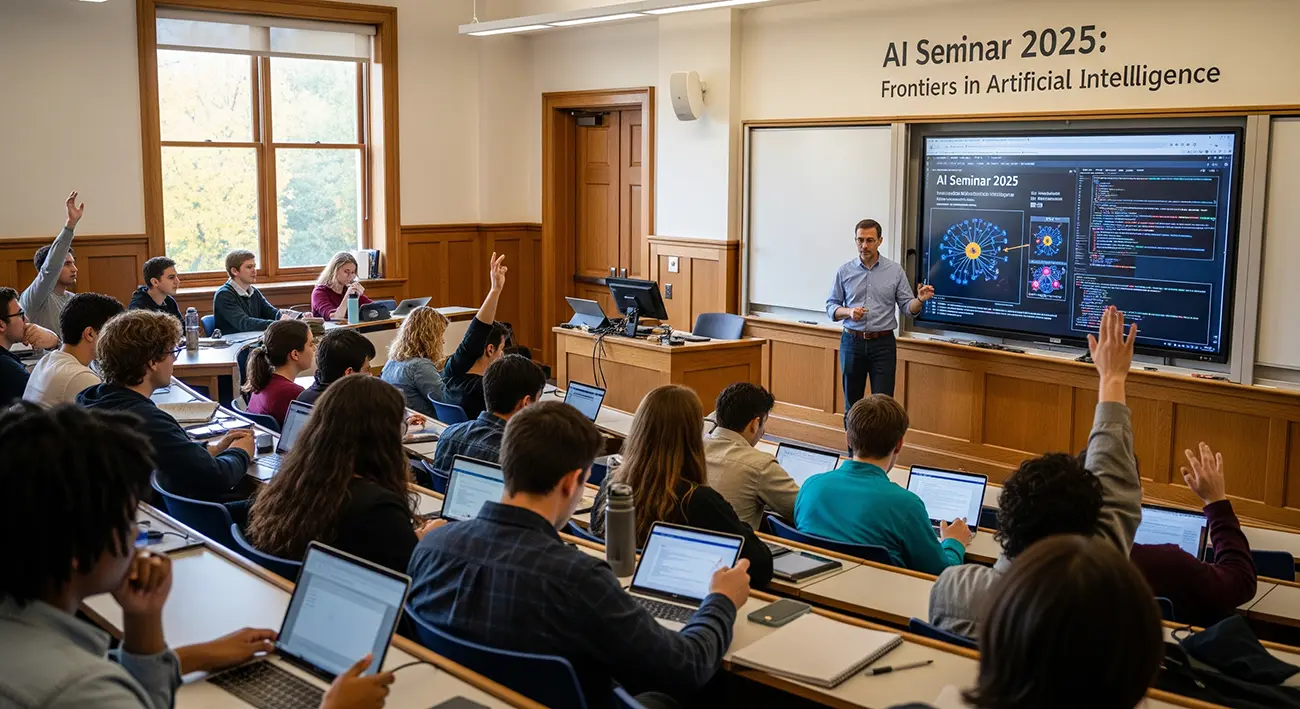
CyberMath Academy students presenting machine learning projects · Harvard Faculty Club · Boston, MA
Machine Learning at CyberMath Academy — Harvard Boston
Our AI and Machine Learning track at CyberMath Academy’s Summer 2026 program — Harvard Faculty Club, Boston, MA, July 20–31 — builds genuine mathematical understanding of machine learning from the ground up.
Students begin with the mathematical foundations: linear algebra, probability, and the calculus of optimization. They build simple models by hand before touching any code. They understand why gradient descent converges before they implement it. By the end of the program, they have trained real neural networks on real datasets and understand every step of the process.
The instruction comes from active researchers. Igor Ganichev, from the Google Brain team, teaches machine learning foundations. Dr. Umut Eser, Head of Machine Learning at Cellarity, demonstrates how these tools are applied in medical research. Nicholas Pascucci brings the perspective of AI verification — the mathematics of proving that systems work correctly.
No prior coding experience is required. What is required is mathematical curiosity and the willingness to work hard on genuinely difficult problems.
“I came in knowing how to use ChatGPT. I left understanding how it works. That is a completely different thing — and I could feel the difference immediately.”
— CyberMath Academy student · Summer 2025 · AI Track