
Sabrina Gonzalez Pasterski: The Real Story Behind the “Next Einstein” Headlines
The Journey: From Garage to Gravitational Physics

Early mechanical aptitude: Pasterski’s hands-on approach began with aviation projects at age 14
2006 (Age 14)
Built a single-engine airplane from a kit in her family’s garage, completing FAA inspections and flying it solo. This early engineering project demonstrated her unique combination of practical skill and theoretical understanding.
2010
Graduated from Illinois Mathematics and Science Academy; Accepted to MIT with a “most impressive” rating from faculty who recognized her exceptional potential in both applied and theoretical domains.
Academic progression: From MIT undergraduate to Harvard PhD candidate in theoretical physics
Pasterski’s transition from MIT to Harvard marked a shift from applied engineering to fundamental theoretical physics. At Harvard, she began working under Andrew Strominger, one of the world’s leading theoretical physicists specializing in string theory and quantum gravity.
Her research at Harvard focused on some of the most challenging problems in theoretical physics, including celestial holography and the memory effect of gravitational waves. These areas of study represent the cutting edge of attempts to reconcile quantum mechanics with Einstein’s theory of general relativity.
2016
Graduated from MIT with perfect 5.0 GPA; Began PhD at Harvard under advisor Andrew Strominger, one of the world’s leading theoretical physicists working on string theory and quantum gravity.
2021
Completed PhD with thesis: “These include celestial holography and memory effect,” contributing to our understanding of how information is preserved in black holes and gravitational systems.
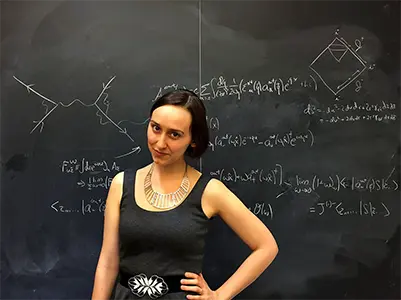
Groundbreaking Research: Where Math Meets the Cosmos
Pasterski’s work sits at the intersection of quantum mechanics and general relativity—perhaps the most challenging frontier in theoretical physics. Her specific contributions include:Celestial Holography
Exploring how information about 3D spacetime might be encoded on 2D surfaces, potentially resolving the black hole information paradox. This work bridges concepts from quantum information theory, gravitational physics, and advanced geometry.Memory Effect
Investigating how gravitational waves leave permanent imprints on spacetime—a prediction of Einstein’s theory now being tested by observatories like LIGO. Pasterski’s mathematical frameworks help interpret these cosmic signals.Soft Theorems
Working on mathematical relationships connecting different types of particles and forces at quantum levels. These theorems reveal deep symmetries in physical laws that aren’t apparent in traditional formulations.“Physics itself is exciting enough. It’s not like a 9-to-5 thing. When you’re tired you sleep, and when you’re not, you do physics.” — Sabrina Gonzalez Pasterski
The Cybermath Connection: Building Your Foundation
What can we learn from Pasterski’s trajectory that applies to aspiring scientists and mathematicians? Her journey illustrates three critical principles:Start with Hands-On Projects
Pasterski didn’t begin with abstract equations—she started with wrenches, engines, and flight manuals. Her airplane project taught practical problem-solving that later translated to theoretical physics. The tactile understanding of mechanical systems informed her later work on fundamental physical principles. Application: Begin with tangible projects. Code a simple game, build a robot, or simulate a physical system. These practical experiences build intuition that pure theory cannot provide.Master the Mathematical Language
Her research relies on advanced differential geometry, topology, and quantum field theory. Pasterski’s genius isn’t just intuition—it’s mathematical fluency. She can translate physical questions into precise mathematical formulations and back again. Application: Solidify your foundation in calculus, linear algebra, and differential equations. These are the tools that decode the universe. At Cybermath, we structure our curriculum to build this mathematical vocabulary systematically.Embrace Challenges as Starting Points
As a young woman in male-dominated fields (aviation then physics), Pasterski faced skepticism. She responded with exceptional work rather than debate, letting her results speak for themselves. Application: Focus on creating undeniable value through projects and research. When facing obstacles, channel energy into producing work that cannot be ignored. Quality output is the most powerful response to doubt.Ready to Build Your Foundation?
The journey from curiosity to breakthrough begins with mathematical mastery. Whether you’re exploring quantum concepts or computational physics, your toolkit starts with a solid foundation in mathematical thinking. Explore Cybermath CoursesStart with our “Mathematical Methods for Physics” pathway designed to build the analytical skills needed for advanced research.
Beyond the Lab: Changing Science Culture
Pasterski maintains an active online presence through her website PhysicsGirl.com, where she documents her research and shares insights. She consciously avoids traditional social media hype, focusing instead on substantive scientific communication through her curated platform. Her approach offers an alternative model for scientific celebrity in the digital age: substance over spectacle, papers over posts. By controlling her digital presence, she maintains focus on research while still engaging with the broader scientific community.By the Numbers
First
Female to build and fly her own plane solo in Illinois teen aviation history, demonstrating early boundary-breaking achievement
5.0
Perfect GPA recommendation from MIT faculty, reflecting exceptional academic performance
20+
Peer-reviewed publications before age 30, showing prolific research output
0
Traditional social media accounts, maintaining focused research environment
The Real Lesson: Mathematical Thinking as Superpower

From practical engineering to theoretical physics: Pasterski’s journey demonstrates the power of mathematical thinking across domains