How to Think Like a Mathematician: 5 Habits That Change Everything
by CayberMath Academy • May 8 2026 • Blog
Most students are taught mathematics as a collection of techniques. Learn this formula. Apply this method. Get the right answer. Move on.
This approach produces students who can execute procedures — but who freeze when they encounter a problem that does not fit a familiar pattern. And in the real world, in research, in engineering, in AI, and in business, virtually every important problem is one that does not fit a familiar pattern.
Mathematical thinking is something different. It is not a set of techniques. It is a set of habits — ways of approaching problems, evaluating claims, constructing arguments, and tolerating uncertainty — that transfer across every domain of thought. Developing these habits early changes not just how students do mathematics, but how they think about everything.
Here are five of the most important ones, illustrated with examples we use at CyberMath Academy.
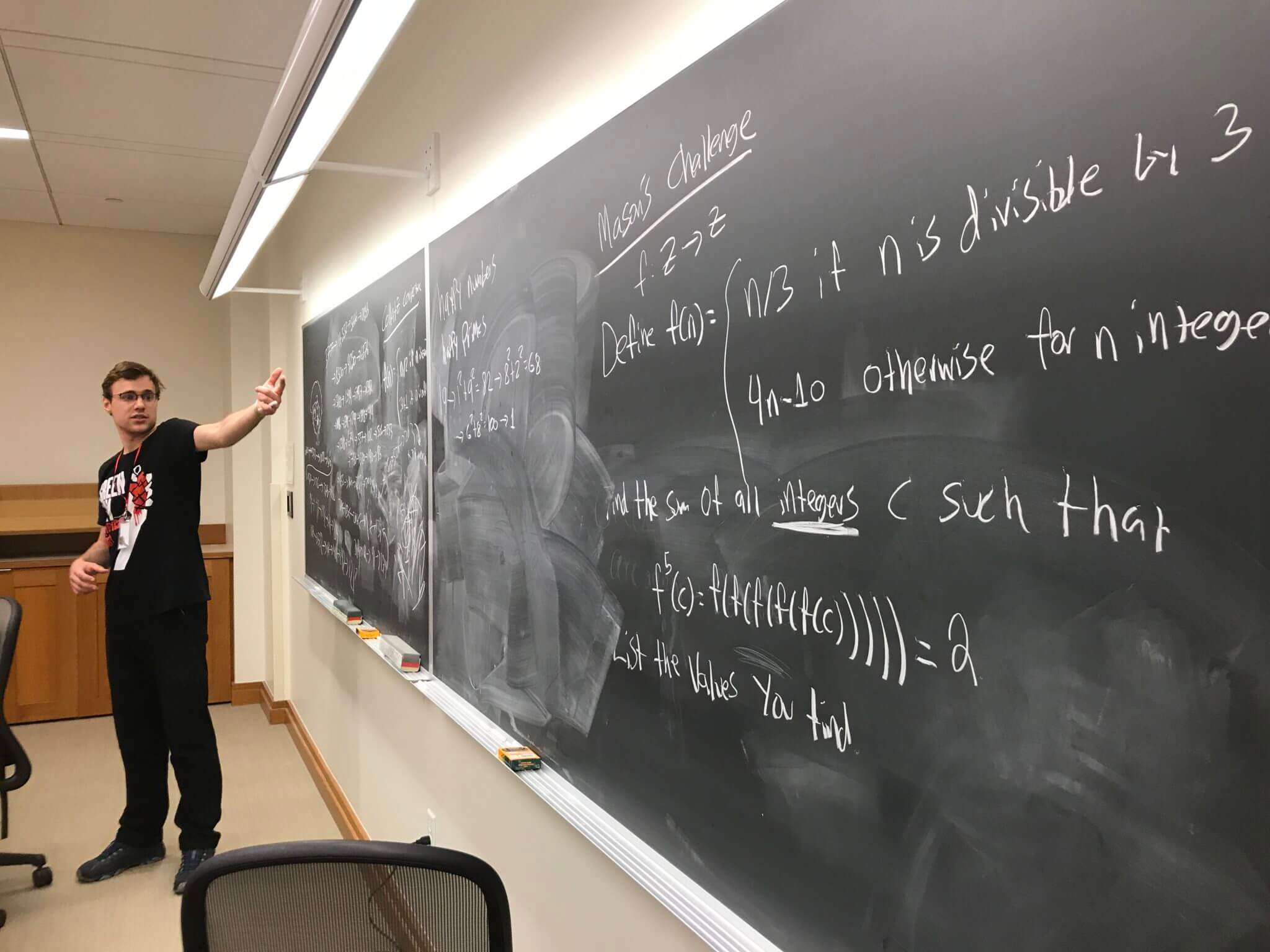
CyberMath Academy · Harvard Faculty Club · Boston, MA · July 20–31, 2026
1. Resist the First Answer
The single most powerful habit in mathematical thinking is also the least natural: pausing before committing to an answer.
Most people, confronted with a problem, generate a response and then look for reasons to believe it. Mathematicians do the opposite. They generate a response and then look for reasons it might be wrong.
The Monty Hall Problem is the perfect illustration. The setup is simple: there are three doors, a prize behind one, and goats behind the other two. You pick Door 1. The host — who knows where the prize is — opens Door 3, revealing a goat. Should you switch to Door 2?
Most people, including many mathematicians when first encountering the problem, answer no. It seems obvious: two doors remain, so it must be 50/50. Switching cannot help.
But this is wrong. Switching wins the prize two-thirds of the time. Staying wins only one-third of the time.
Why? Because the host’s choice carries information. The host always opens a losing door — which means that when you originally picked a losing door (a 2-in-3 chance), switching always wins. The intuition of “50/50” ignores the structure of the problem entirely.
The lesson is not the answer to the Monty Hall Problem. The lesson is that your first answer — especially when it feels obvious — is worth examining carefully. Mathematical thinkers have learned, through repeated experience, that the obvious answer is often wrong in subtle and interesting ways.
2. Ask “Why?” Not Just “What?”
There is a profound difference between knowing that something is true and knowing why it is true.
A student who has memorized that the angles in a triangle sum to 180° knows a fact. A student who can prove it — who understands that this follows from the parallel postulate, and that in non-Euclidean geometry it is not true — understands geometry.
The habit of asking “why” transforms mathematics from a collection of facts into a coherent structure. It also reveals when the “facts” you have been taught are actually approximations, special cases, or outright errors.
Consider the claim that the square root of 2 is irrational. Most students accept this as a fact, because their teacher told them so. A student who has worked through the proof by contradiction — who has seen exactly why assuming √2 = p/q leads to an impossibility — understands it in an entirely different way. They could rediscover it if they forgot it. They could recognize similar arguments in other contexts. They own the idea rather than renting it.
At CyberMath Academy, we never ask students to accept mathematical claims on authority. Every major result we introduce, we prove — completely, rigorously, and in a way that makes the proof feel inevitable rather than arbitrary. This takes more time than teaching facts. It produces fundamentally different mathematical thinkers.
3. Make the Problem Smaller (or Bigger)
When confronted with a hard problem, novice problem-solvers try to solve it directly. Expert problem-solvers first ask: is there a simpler version of this problem that I can solve?
This is not avoiding the problem. It is a systematic strategy for building understanding. Solving the simplified version often reveals the structure that makes the original problem tractable.
The Traveling Salesman Problem is a beautiful example. The question is simple to state: given a list of cities, what is the shortest route that visits each city exactly once and returns to the starting point? With 10 cities, there are 181,440 possible routes. With 20 cities, more routes exist than atoms in the observable universe.
No perfect algorithm exists for solving this problem efficiently in general — it remains one of the most famous unsolved problems in computer science. But working on small cases (3 cities, 4 cities) reveals the structure. You see why the problem is hard. You understand what “exponential growth” really means. You begin to appreciate why approximate solutions — algorithms that find routes close to optimal in reasonable time — are practically important even if they are theoretically imperfect.
The complementary strategy — making the problem bigger — is equally powerful. When a specific case is confusing, generalizing it sometimes makes the underlying pattern clearer. This is counterintuitive but repeatedly effective: the general case is sometimes easier to understand than the specific one.
4. Separate “Seems True” from “Is True”
One of the most important — and most difficult — habits in mathematical thinking is learning to distinguish between a claim that seems plausible and a claim that has been proven.
In everyday life, we routinely accept claims based on plausibility, authority, or consistency with our existing beliefs. This is often reasonable. We do not have time to verify everything from first principles. But in mathematics and in careful reasoning generally, it is a systematic source of error.
The history of mathematics is full of conjectures — claims that seemed true, that held for every case anyone checked, that the greatest mathematicians of their time believed — that turned out to be false. Euler’s conjecture about sums of powers seemed obviously true for over 200 years before a counterexample was found. The Riemann Hypothesis has been verified for billions of cases and remains unproven.
In our AI track at CyberMath Academy, we make this concrete through the concept of overfitting. A machine learning model that performs perfectly on its training data — that “seems” to work — can fail catastrophically on new data it has never seen. The model has learned patterns that happen to be consistent with the training examples but do not reflect genuine structure. It has confused “seems true in the cases I’ve checked” with “is true in general.”
Learning to maintain appropriate skepticism — about your own conclusions and about claims you encounter — is one of the most transferable skills that mathematical training develops.
5. Embrace Being Wrong as Information
Perhaps the deepest habit of mathematical thinking is a particular relationship with error.
Most educational environments treat mistakes as failures — evidence of insufficient preparation, inadequate ability, or incomplete understanding. Students learn to avoid being wrong, which means they learn to avoid situations where they might be wrong: hard problems, unfamiliar territory, genuine intellectual risk.
Mathematicians have a different relationship with error. A wrong approach is not a failure. It is information. It tells you something about the structure of the problem. It eliminates a direction. It often reveals, in its wrongness, exactly what the right approach requires.
The best mathematical thinking happens in the space between first attempt and eventual understanding — in the working-through of wrong approaches that gradually converge on something right. Students who have been taught to fear error cannot inhabit this space. They are too anxious to be wrong to think carefully.
At CyberMath Academy, we deliberately create an environment where being wrong is expected and respected. Our instructors — an IMO Gold Medalist, a Google Brain engineer, a Harvard Medical School researcher — share their own wrong approaches. They talk about problems that took them weeks or months to understand. They model the relationship with difficulty that they want students to develop.
This is not merely pedagogically sound. It is how real mathematical work happens.
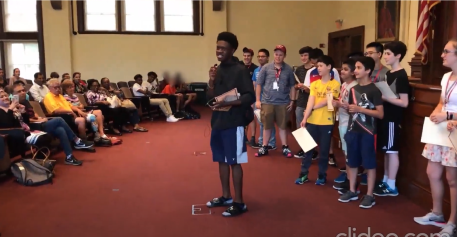
Late-night problem sessions — the real work of mathematical thinking
These Habits Are Learnable — at Any Age
None of these five habits are innate. They are not reserved for students who were born with unusual mathematical ability. They are learnable — through exposure to the right problems, the right environment, and the right instruction.
They are also learnable at a surprisingly young age. We have seen students aged 10 and 11 develop genuine mathematical skepticism, real proof-writing ability, and an authentic relationship with difficulty — if they are placed in the right environment and challenged appropriately.
The window for developing these habits is not infinite. Students who spend their formative mathematical years executing procedures without understanding them can develop deeply ingrained habits that are genuinely difficult to change later. The earlier the exposure to real mathematical thinking, the more natural these habits become.
The Environment That Develops These Habits
Developing mathematical thinking habits requires more than good instruction. It requires an environment that makes these habits necessary and rewarded.
At CyberMath Academy’s Summer 2026 program at Harvard Faculty Club, Boston, MA (July 20–31), students are surrounded by peers who take mathematical thinking seriously — students from 50+ countries who have self-selected into an intensive program. They are instructed by active researchers who model these habits in their own work. They are challenged with problems that cannot be solved by formula application alone.
The result, consistently, is students who leave thinking differently — not just about mathematics, but about how to approach any hard problem they encounter.
“My son came home and started questioning everything — not in an annoying way, but in a thoughtful way. He wanted to understand why things worked, not just that they did. That was new.”
— Parent · Texas, USA · CyberMath Academy Summer 2025