From Curious Student to Future Scientist: What Happens to CyberMath Academy Alumni
Parents often ask us one question above all others: “What actually changes?”
Not during the program — they can see that. The late-night conversations about unsolved problems, the friendships forged over two weeks of shared difficulty, the moment a student realizes they can do something they thought was beyond them. Those changes are visible in real time.
The question is what persists. What carries forward from two weeks at Harvard Faculty Club, Boston, MA into the months and years that follow. What a student does differently — or becomes differently — because of what happened at CyberMath Academy.
This is our attempt to answer that honestly.

The Immediate Changes Parents Notice
Before addressing the long-term, it is worth acknowledging what parents tell us they observe in the days immediately following camp. These short-term changes are not trivial — they are often the seeds of the longer-term ones.
Confidence. This is the most commonly reported change, and it is not confidence in the abstract. It is specific confidence: the willingness to attempt problems that feel hard, to ask questions in class without embarrassment, to say “I don’t know yet” rather than “I can’t do this.” Students who have spent two weeks working through genuinely difficult mathematics alongside peers who are equally challenged — and equally undeterred — develop a different relationship with difficulty.
Direction. A significant number of students arrive at CyberMath Academy without a clear sense of what they want to study or pursue. They know they are interested in mathematics or science, but the field feels abstract — a collection of subjects rather than a set of possible lives. After two weeks of exposure to researchers who have made specific careers out of specific mathematical interests, many students leave with a much clearer sense of direction. Not a fixed plan — that would be premature — but a direction.
Standards. Students who have been the strongest mathematicians in their school often arrive at CyberMath Academy and encounter, for the first time, peers who are as strong or stronger. This can be uncomfortable. It is also, in our experience, one of the most valuable things that can happen to a gifted young learner. The recalibration of standards — upward — tends to produce sustained improvement in a way that unchallenged excellence does not.
“My son came home a completely different student. His confidence in math skyrocketed and he made friends from six different countries. Best investment we’ve ever made in his education.”
— Jennifer M., Parent · California, USA
The Academic Outcomes
We are careful about how we describe academic outcomes, because the causal relationship between a summer program and later achievements is genuinely difficult to establish. A student who attends CyberMath Academy and later gains admission to MIT would have been an exceptional student regardless. We cannot claim the credit for their abilities.
What we can say is this: the skills developed at CyberMath Academy — rigorous mathematical reasoning, proof-writing, the ability to engage with genuinely hard problems, facility with the mathematical foundations of AI and machine learning — are exactly the skills that elite universities are looking for, and that standardized tests and school curricula often do not develop.
University admissions. CyberMath Academy alumni have been accepted at MIT, Stanford, Princeton, Harvard, Caltech, Berkeley, Carnegie Mellon, and other top-tier institutions. We do not publish these figures as proof that our program “gets students into” these universities — the students got themselves in. But the skills and experiences gained at CyberMath Academy are genuinely relevant to what selective universities are looking for: intellectual ambition, the willingness to engage with difficulty, and evidence of having pushed beyond the standard curriculum.
Competition mathematics. Students who attend our competition mathematics tracks — AMC, AIME, Olympiad preparation — consistently report significant improvement in subsequent competition results. The combination of expert instruction, intensive practice, and a peer environment of similarly motivated students produces accelerated improvement that is difficult to replicate through solo study or standard tutoring.
Research and independent projects. Several CyberMath Academy alumni have gone on to conduct independent research projects in mathematics and computer science. One student, who attended our program at age 16, built a machine learning model for cancer detection during the two-week program and later presented a refined version of that project at a regional science competition. Another pursued a research internship at a university laboratory, citing the foundation in mathematical reasoning developed at CyberMath Academy as essential preparation.
The Network That Persists
One of the less tangible but deeply real outcomes of CyberMath Academy is the peer network that students leave with.
When 200 students from 50 countries spend two weeks doing genuinely difficult mathematics together, something happens that is more than friendship. They become members of a community — a dispersed, informal, self-selected community of young people who take mathematics seriously and who have demonstrated, by showing up, that they are willing to work hard at things that are genuinely difficult.
This community persists. Alumni stay in touch. They share problems, resources, and opportunities. They apply to the same universities and end up in the same programs. They collaborate on projects. Several have co-authored research papers. Some have started companies together.
We cannot manufacture this. It emerges naturally from the concentration of the right people in the right environment. But we can create the conditions for it — and we have, for eight consecutive summers.
The Change in Identity
The deepest and most durable change that CyberMath Academy produces is not in skills or knowledge. It is in how students see themselves.
Many gifted mathematics students, particularly those from smaller communities or schools with limited advanced offerings, carry a particular kind of intellectual loneliness. They are good at mathematics — often the best in their school — but they have no peers who share their interest. They may love the subject but have never had the experience of being in a room full of people who love it equally.
Two weeks at CyberMath Academy changes this. Not by telling students they are special — they know that, and it is not particularly useful to hear — but by giving them the experience of belonging to a community of people like themselves. Of having peers who find the same things interesting, who stay up late for the same reasons, who feel the same satisfaction when a hard problem finally yields.
This identity shift — from “I am a student who is good at math” to “I am a mathematician, and there are others like me” — is subtle but profound. Students who make this shift tend to pursue mathematics more ambitiously, more persistently, and with more genuine pleasure than those who do not.
“They live in a small rural town. They gained inspiration at your program that they couldn’t find anywhere near home. No words can fully express my gratitude.”
— Sarah, Parent · Vermont, USA
What Students Tell Us
We ask alumni, at various points after their program, what they feel they took away. The answers cluster around a few consistent themes.
“I learned how to be wrong.” Several alumni, unprompted, identify this as one of the most important things they took from CyberMath Academy. Not the tolerance of being wrong — the ability to be wrong productively, to extract information from an incorrect approach rather than abandoning it, to treat error as data rather than verdict. This is not something most schools teach explicitly. At CyberMath Academy, the environment makes it necessary.
“I found my people.” The peer network is consistently cited, often in these exact words. Students who arrived as strangers and left as friends return to this experience as a reference point for what intellectual community feels like — and it raises their standards for the communities they seek out subsequently.
“I understood for the first time that mathematics is alive.” Exposure to researchers working at the frontier of mathematics and AI — people who are genuinely uncertain about outcomes, who are wrestling with unsolved problems, who bring the excitement of discovery into the classroom — changes students’ understanding of what mathematics is. It is not, it turns out, a collection of techniques to be memorized. It is an ongoing human activity, full of open questions and genuine surprises.
“I knew what I wanted to do.” Direction — not certainty, but direction — is one of the most valuable things CyberMath Academy provides. Students who were uncertain about their futures arrive with questions and leave with hypotheses. Not final answers, but a much clearer sense of which paths are worth exploring.
The Credential That Carries Weight
CyberMath Academy is WASC authorized — one of the very few summer programs in the world to hold this accreditation. This means that our academic standards are externally verified, and that the credentials we issue carry real weight.
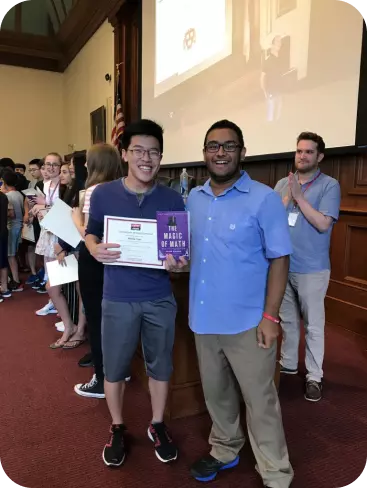
Students who complete our program receive a Certificate of Completion. Those who achieve a B+ or above receive a Certificate of Mastery. Those who demonstrate exceptional academic leadership and engagement are eligible for letters of recommendation from our instructors. All students receive a formal letter grade (A through F) — a genuine academic record, not a participation certificate.
These credentials are relevant to university applications, scholarship applications, and academic program admissions. They document not just attendance at a summer program but demonstrated performance in a rigorous academic environment, taught by faculty from some of the world’s leading research institutions.
Summer 2026 — Harvard Faculty Club, Boston, MA
Our Summer 2026 program runs July 20–31 at Harvard Faculty Club, Boston, MA. Students aged 9–16 are welcome at all mathematical levels. No prior coding experience is required for our AI and Machine Learning track.
The changes described in this article do not happen automatically. They happen in the right environment, with the right people, under the right conditions. We have spent eight years building those conditions. The question, as always, is whether your child will be in the room.