A Day in the Life at CyberMath Academy: What Really Happens at Harvard Summer Math Camp
Parents often ask us: “What actually happens during those two weeks?” It’s a fair question. A lot of summer programs sound impressive on paper and deliver something far more ordinary in practice. So we want to give you an honest, detailed picture of what a day at CyberMath Academy’s Harvard summer math camp actually looks like — from the moment students arrive to the friendships they take home.
Arrival Day: Strangers Become Classmates
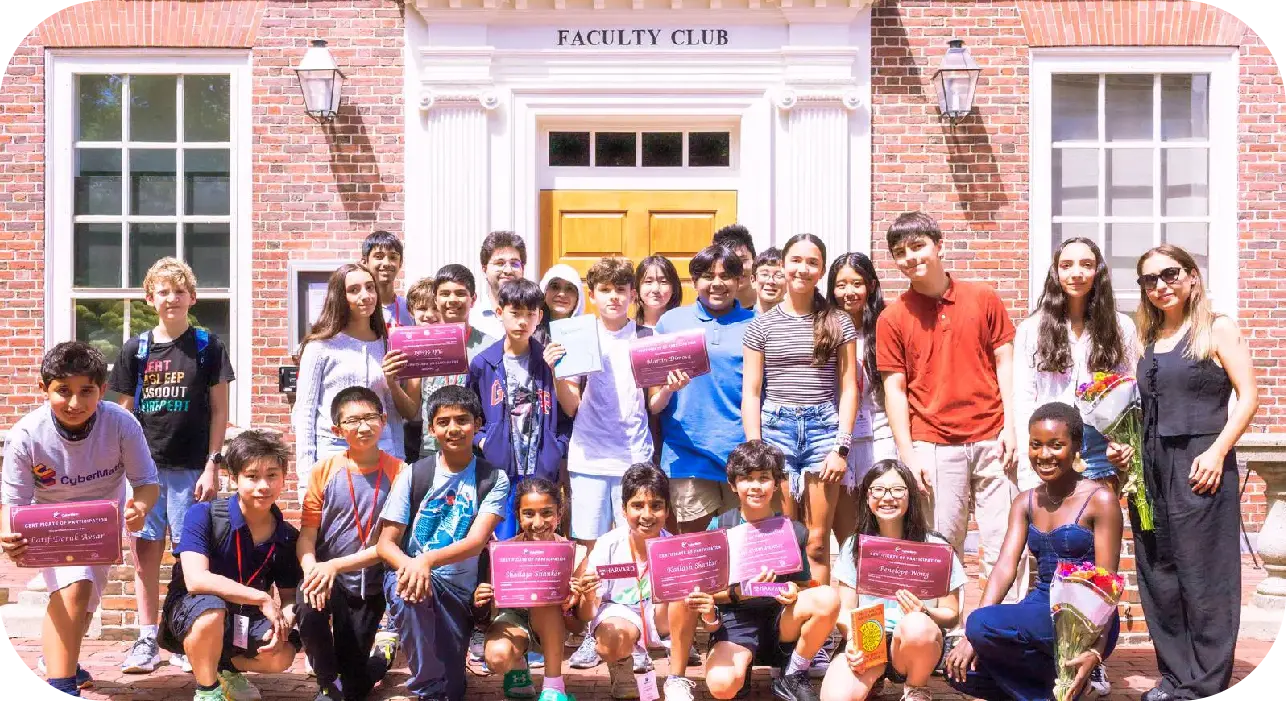
International students arrive on July 19th. US-based students arrive on the morning of July 20th. The first thing most students notice is how different their peers are — in background, nationality, and academic experience — and how immediately that stops mattering.
Within hours, a student from Iowa is explaining a chess strategy to a student from Singapore. A student from Turkey is helping someone from California with a probability problem. The common language is not English — it is curiosity. And it turns out that curiosity, when concentrated in one room, is a remarkably fast social lubricant.
After a placement exam that assesses mathematical readiness (not knowledge — we are testing how students think, not what they have memorized), students are placed into the appropriate track. Every level is represented: from students who are just beginning to explore proof-based mathematics to those who have already competed at the national olympiad level.
9:00 AM — Morning Classes at Harvard Faculty Club

Classes begin at 9:00 AM and run until 1:00 PM. These are not lectures in the conventional sense. Our instructors — active researchers from MIT, Harvard, Stanford, and Berkeley — do not stand at a whiteboard and explain. They pose problems. They ask questions. They create situations where students are forced to think, disagree, revise, and try again.
A typical morning might look like this:
An instructor begins by writing a single question on the board — something deceptively simple, like: “Is the sum of any two irrational numbers always irrational?” Students work in pairs for fifteen minutes. Then the class shares approaches. Then the instructor dismantles each approach methodically until only one survives. Then someone in the back raises a hand: “Wait, but what if…?”
That moment — that “what if” — is what we are building toward. It is the beginning of mathematical thinking. And in a room full of students who have never had the space to ask it before, it happens again and again.
In the AI and Machine Learning track, mornings are structured differently. Students are introduced to a concept — say, how a spam filter learns from labeled examples — and immediately asked to think about the mathematics underneath it. By the end of the first week, they are writing and testing real models. Not simulations. Not toy examples. Real machine learning code, applied to real datasets.
Afternoon: Workshops, Projects and Guest Lectures
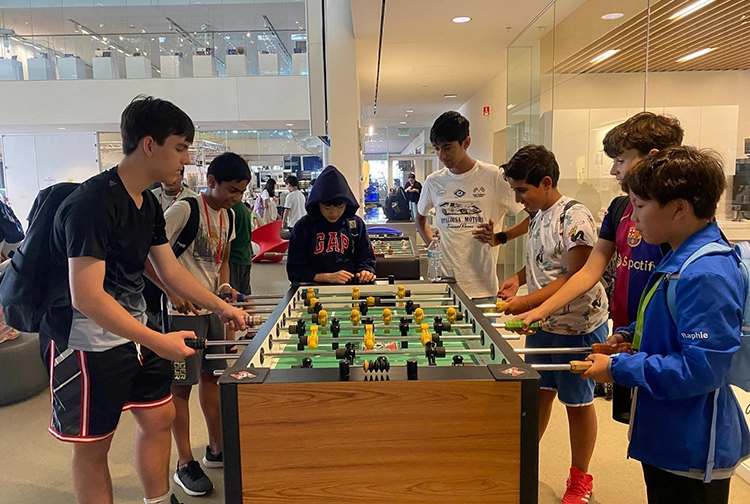
After lunch, the pace changes. Afternoons (2:00–4:00 PM) are for workshops, collaborative projects, and guest lectures from researchers and practitioners in mathematics, AI, and computer science.
These guest sessions are not motivational talks. They are working sessions. A researcher might present the actual problem they are working on — something genuinely unsolved — and ask students to engage with it. Most students find this disorienting at first. They are used to problems that have answers. Working on something where the answer is unknown is a different experience entirely.
It is also one of the most valuable things that can happen to a young learner.
Some of the researchers who have presented at CyberMath camps include members of the Google Brain team, Harvard Medical School scientists using AI to model disease at the cellular level, Stanford Bio-X researchers working on prosthetic limbs guided by neural signals, and NASA engineers who use formal mathematical methods to verify AI systems before they are deployed on spacecraft.
These are not people who talk about what mathematics can do. They are people doing it — and they bring that into the room.
Evenings: The Part Nobody Talks About — But Everyone Remembers
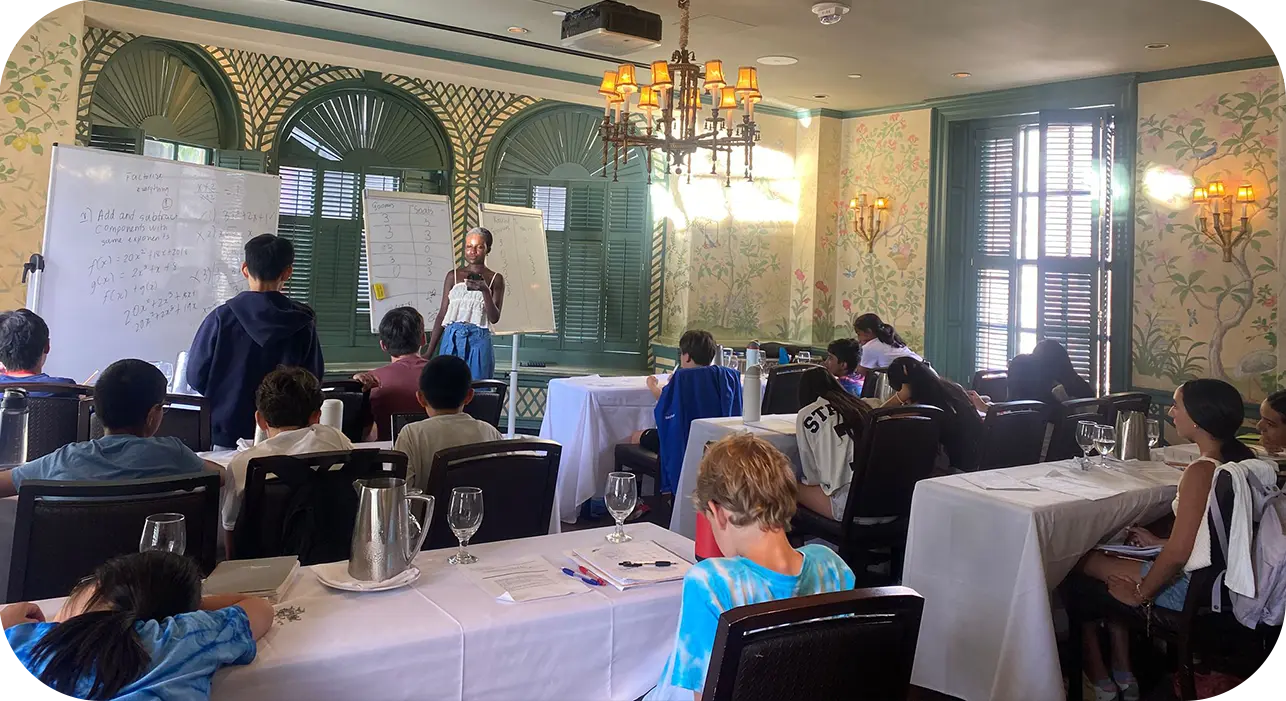
The curriculum ends at 4:00 PM. The education does not.
Residential students eat dinner together in the evenings, and somewhere between the meal and the end of the night, something shifts. Students who have spent the day wrestling with the same problems find themselves still talking about them. Someone pulls out a notebook. Someone else challenges a conclusion from the afternoon. A small group stays up later than they should, not because they have to, but because the conversation is more interesting than sleep.
This is not something we engineered. It is what happens when you put genuinely curious people in a room together and give them permission to think.
Evening activities include supervised study time, informal math circles, campus walks, and social events. During the program, students also take part in a Boston city tour and guided visits to the Harvard campus — reminders that they are not just at a summer program, but on one of the most storied university campuses in the world.
The Last Day: Award Ceremony
On July 31st, the final day of camp, CyberMath holds its award ceremony. Certificates of Completion are awarded to all students who complete the program. Certificates of Mastery go to students who achieve a B+ or above. Letters of recommendation are available for eligible students who demonstrate academic leadership and engagement throughout the two weeks.
Something else happens on the last day, too, which is harder to document. Students exchange contact information with people they met five days ago and already consider friends. Parents who drove in to pick up their children sometimes tell us they barely recognize the person walking toward them — not because they look different, but because they carry themselves differently.
That is the part that does not appear in the curriculum. It is also, we think, the most important part of what we do.
What Parents Tell Us Afterward
“My son came home a completely different student. His confidence in math skyrocketed and he made friends from six different countries. Best investment we’ve ever made in his education.”
— Jennifer M., Parent · California, USA
“They live in a small rural town. They gained inspiration at your program that they couldn’t find anywhere near home. No words can fully express my gratitude.”
— Sarah, Parent · Vermont, USA
“The instructors from MIT were incredible — they made complex topics feel exciting. My daughter is now seriously considering a STEM career. CyberMath exceeded every single expectation we had.”
— Robert K., Parent · New York, USA
Program Details — Summer 2026
- 📍Location: Harvard Faculty Club, Cambridge MA
- 📅Dates: July 20–31, 2026 (International arrivals July 19)
- 👤Ages: 9–16
- 🎓Accreditation: WASC Authorized
- 📚Tracks: Mathematics, AI & Machine Learning, Competition Math, SAT Prep
- ✈️Options: Day student and residential (includes accommodation and all meals)
Questions? [email protected] · cybermath.org