
5 Mind-Blowing Probability Problems That Will Change How You Think About Math
Probability is the branch of mathematics that deals with uncertainty — and it is, without question, the area of mathematics most likely to produce a result that makes you say “that cannot possibly be right.”
The problems below have stumped professors, embarrassed statisticians, and started arguments at dinner tables around the world. They also appear regularly in our weekly math quiz reels — because nothing sparks curiosity about mathematics faster than a result that feels impossible until you understand why it is true.
Work through each one before reading the explanation. The discomfort of being wrong is exactly where the learning happens.
Problem 1: The Birthday Paradox
The Question
How many people do you need in a room for there to be a greater than 50% chance that at least two of them share the same birthday?
Take a moment. The year has 365 days. What is your instinct?
What Most People Think
Most people answer somewhere between 180 and 200 — roughly half of 365. It feels logical. If you need a 50% chance of a match across 365 possible birthdays, you should need about half that many people, right?
The Real Answer: 23
You only need 23 people. With just 23 people in a room, the probability that at least two share a birthday exceeds 50%. With 50 people, it reaches 97%.
This is the Birthday Paradox — and the reason it surprises everyone is that people think about the wrong thing. The question is not “what is the chance that someone shares my birthday?” It is “what is the chance that any two people in the room share a birthday?” Those are completely different questions.
The Mathematics
It is easier to calculate the probability that no two people share a birthday, and subtract from 1.
With 2 people: the second person must avoid the first person’s birthday. Probability of no match = 364/365.
With 3 people: the third person must avoid both previous birthdays. Probability of no match = (364/365) × (363/365).
With 23 people: probability of no match = (364/365) × (363/365) × … × (343/365) ≈ 0.493.
So the probability that at least one match exists = 1 − 0.493 = 0.507, or just over 50%.
The key insight is that with 23 people, there are 23 × 22 / 2 = 253 pairs of people, each of which could potentially share a birthday. When you think about it that way, 50% starts to feel inevitable rather than impossible.
This result has real-world applications in cryptography, hashing algorithms, and security systems — the same mathematical structure determines how quickly collisions appear in hash functions used to secure data.
Problem 2: The Monty Hall Problem
The Question
You are on a game show. There are three doors. Behind one door is a car. Behind the other two are goats.
You pick Door 1. The host — who knows what is behind every door — opens Door 3 and reveals a goat. He then asks: would you like to switch to Door 2, or stay with Door 1?
Does it matter? Should you switch?
What Most People Think
Most people say it doesn’t matter. “There are two doors left and one car — so it’s 50/50. Switching makes no difference.”
This answer is wrong. And it is wrong in a way that has caused genuine controversy. When the correct answer was published in a magazine column in 1990, the author received thousands of letters from readers — including many with PhDs in mathematics — insisting she was mistaken. She was not.
The Real Answer: Always Switch
Switching wins 2 out of 3 times. Staying wins only 1 out of 3 times.
The Mathematics
When you first pick Door 1, the probability that the car is behind Door 1 is 1/3. The probability that the car is behind one of the other two doors is 2/3.
When the host opens Door 3 to reveal a goat, something important happens: he has given you information. He has not revealed Door 2. The 2/3 probability that was spread across Doors 2 and 3 now concentrates entirely on Door 2.
In other words:
- Probability car is behind Door 1 (your original pick): 1/3
- Probability car is behind Door 2 (the switch): 2/3
The host’s action does not change the probability of your original pick. It reveals information that makes Door 2 more likely to be correct.
You can verify this by thinking through all possible scenarios. If the car is behind Door 1 (probability 1/3): staying wins, switching loses. If the car is behind Door 2 (probability 1/3): the host opens Door 3, switching wins. If the car is behind Door 3 (probability 1/3): the host opens Door 2, switching wins.
Switching wins in 2 out of 3 scenarios. Always switch.
This problem is a beautiful demonstration of conditional probability — the probability of an event given that something else has already happened. It is one of the core concepts in probability theory, with applications in medical diagnosis, machine learning, and Bayesian reasoning.
Problem 3: The Boy or Girl Paradox
The Question
A family has two children. You are told that at least one of them is a boy. What is the probability that the other child is also a boy?
What Most People Think
Most people immediately answer 1/2. There are two possible genders. The other child is either a boy or a girl. So it’s 50/50.
The Real Answer: 1/3
The probability that both children are boys is 1/3, not 1/2.
The Mathematics
List all possible combinations of two children (using B for boy and G for girl):
- Boy, Boy (BB)
- Boy, Girl (BG)
- Girl, Boy (GB)
- Girl, Girl (GG)
All four are equally likely. But you have been told that at least one child is a boy. This eliminates Girl, Girl. The remaining possibilities are BB, BG, and GB — three equally likely outcomes. Only one of them (BB) has both children as boys.
Probability = 1/3.
The reason this feels wrong is the same as the Monty Hall Problem: we do not intuitively account for the information we have been given. The statement “at least one is a boy” does more than it seems. It eliminates one of the four equally likely possibilities, which changes the conditional probability of the other outcomes.
Note: There is a version of this problem where you are told “the older child is a boy.” In that case, the answer really is 1/2 — because specifying which child eliminates a different set of possibilities. The difference between these two versions is itself a lesson in how carefully the conditions of a probability problem must be read.
Problem 4: The Inspection Paradox
The Question
You arrive at a bus stop at a random time. Buses run every 10 minutes on average. How long do you expect to wait?
If you said 5 minutes — you are probably wrong.
The Real Answer: Longer Than 5 Minutes
Unless the buses run at perfectly regular 10-minute intervals, your expected wait time is more than 5 minutes. In many real-world scenarios, it is significantly more.
The Mathematics
Imagine the buses are not perfectly regular. Some intervals are 2 minutes; some are 18 minutes. When you arrive at a random time, you are more likely to arrive during a long interval than a short one — because long intervals occupy more time.
This is the Inspection Paradox, also called the waiting time paradox. It says: when you sample a random point from a process, you are more likely to land in a large interval than a small one — which biases your experience toward longer waits.
This paradox appears everywhere:
- Why the average class size experienced by students is larger than the average class size reported by schools (students are more likely to be in large classes).
- Why your friends on social media seem to have more friends than you (you are more likely to be connected to highly connected people).
- Why the average hospital stay seems longer than statistics suggest (very sick patients stay longer and are overrepresented in any snapshot of hospital occupancy).
The Inspection Paradox is one of the most practically important results in probability — and one of the least known outside of mathematics and statistics.
Problem 5: The Traveling Salesman and Probability
The Question
A salesperson needs to visit 10 cities and return home, traveling each road at most once. How many possible routes are there?
The Answer: 181,440
With 10 cities, there are 9! / 2 = 181,440 possible routes (we divide by 2 because the route from A to B is the same as from B to A in reverse).
With 20 cities: over 60 quadrillion routes.
With 30 cities: more routes than there are atoms in the observable universe.
Why This Matters for Probability
The Traveling Salesman Problem is not technically a probability problem — but it illustrates something crucial about combinatorics and probability: the number of possibilities grows explosively fast.
This has profound implications for probability calculations. When you ask “what are the chances of this specific sequence of events?” — you need to understand how many possible sequences exist. The answer is almost always far larger than intuition suggests.
The Traveling Salesman Problem is also one of the most famous unsolved problems in computer science. No one has found an efficient algorithm to find the shortest possible route through all cities. For large numbers of cities, even the fastest computers in the world cannot find the exact optimal route — they can only approximate it.
At CyberMath Academy, we discuss problems like this in the context of algorithm design, computational complexity, and the real-world limits of computing — topics that come up directly in our AI and Machine Learning track.
What These Problems Have in Common
All five problems share something important: the correct answer is counterintuitive, and the reason it surprises us reveals a genuine limitation in how our brains process probability.
We are pattern-recognition machines, built to make quick decisions based on incomplete information. That is enormously useful for survival. It is not always useful for mathematics. Our intuitions about probability are systematically biased in specific, predictable ways — and understanding those biases is both mathematically and practically valuable.
This is why probability is one of the core topics in our curriculum at CyberMath Academy. Not because it appears on standardized tests (though it does), but because learning to reason correctly about uncertainty is one of the most powerful intellectual tools a young person can develop. It applies to medicine, finance, policy, AI, and everyday decision-making.
Test Yourself — Weekly Math Quiz
Every week on our Instagram (@cybermathacademy), we post a new math or AI quiz — problems exactly like the ones above. Some are probability puzzles. Some are logic problems. Some are questions about how AI systems actually work. All of them are designed to make you think differently about mathematics.
Follow us to get your weekly challenge — and drop your answer in the comments. We read every reply.
Learn Probability for Real — at Harvard, Boston
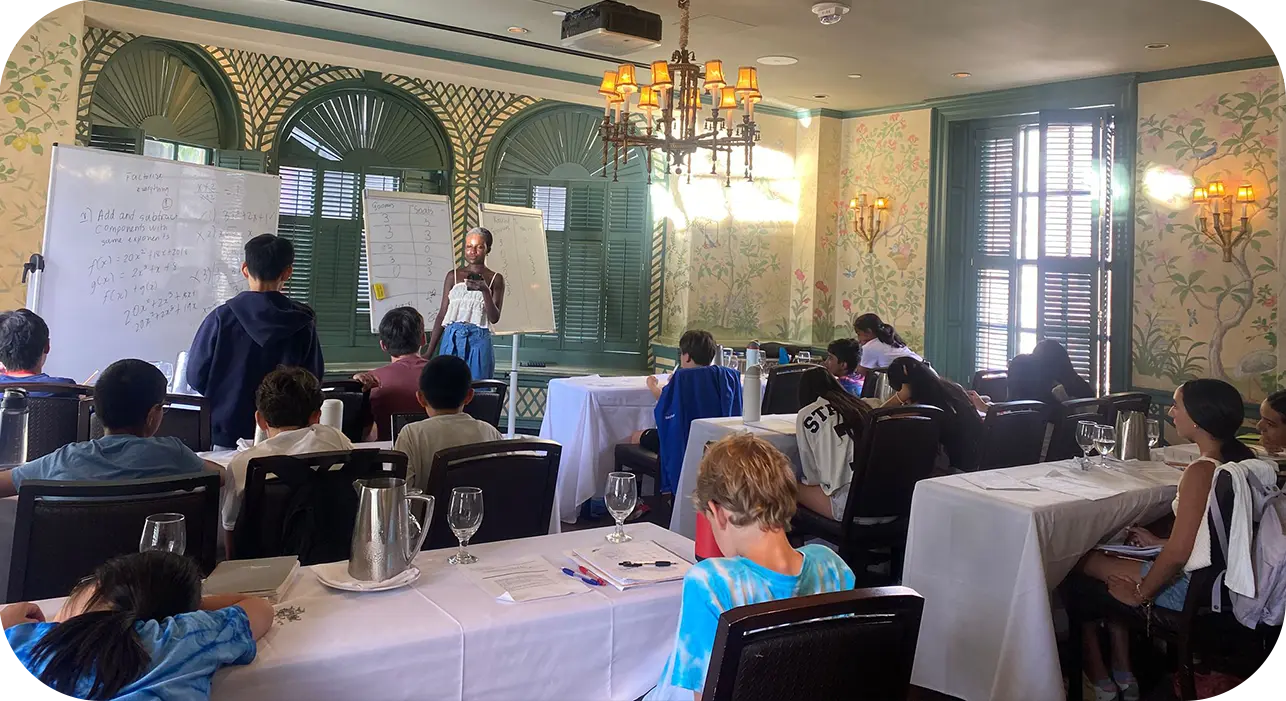
In our Summer 2026 program at Harvard Faculty Club, Boston, probability is not a chapter in a textbook. It is a lens through which students learn to see the world — and a foundation for understanding machine learning, data science, cryptography, and AI.
Students explore:
- Conditional probability and Bayes’ theorem — the mathematical framework underlying every AI system that makes predictions
- Combinatorics — counting principles that determine the number of possible outcomes in complex systems
- Expected value and decision theory — how to make rational decisions under uncertainty
- Probability distributions — how randomness behaves in aggregate, and why this matters for machine learning
Our instructors include active researchers who use probability every day — not just to teach it, but to do it. They bring that into the classroom.
“My daughter is now seriously considering a STEM career. CyberMath exceeded every single expectation we had.”
— Robert K., Parent · New York, USA
Apply for Harvard Boston — July 20–31, 2026
Follow our weekly math quizzes: @cybermathacademy · [email protected] · cybermath.org